
Robotic Knee Replacement
Precision, personalised to your knee — planned in 3D before a single cut is made.
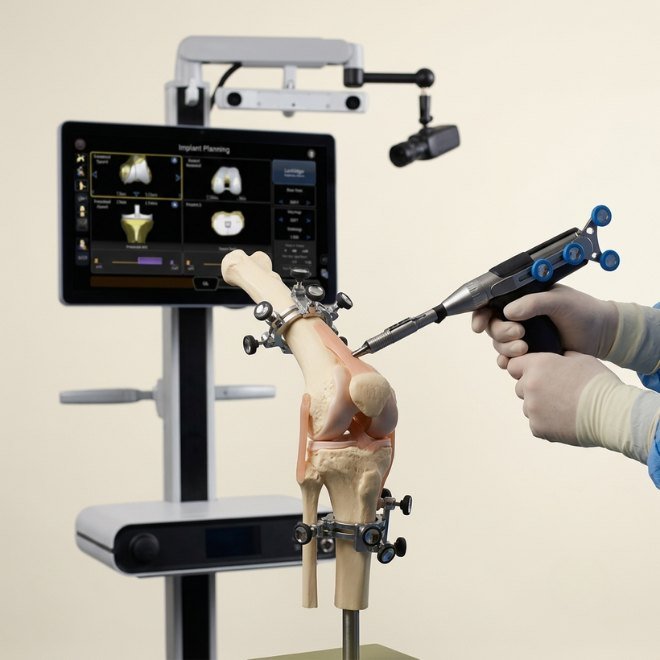
Your knee is mapped in precise 3D, your surgery is planned virtually before a single cut is made, and the robotic system helps execute that plan with sub-millimetre accuracy.
First, let’s clear up the biggest misconception
The robot does not operate on you — your surgeon does. Think of the robotic system as the world’s most precise assistant: it holds the plan, guides the instruments within exact boundaries, and gives your surgeon live feedback throughout.
How it works, step by step
Before surgery, detailed imaging builds a 3D model of your unique knee. On this model, your surgeon plans the ideal implant size, position, and alignment. In theatre, the robotic arm helps carry out this plan exactly, removing only the damaged bone and cartilage while protecting healthy tissue. If the surgeon moves outside the planned safe zone, the system simply won’t cut.
What precision means for you
Better alignment and balance translate into things you can feel: a knee that tracks naturally, less soft-tissue disturbance (which many patients experience as less post-operative pain), and earlier confident walking.
Your questions, answered
Is robotic surgery safer?
The robotic system adds guardrails to an already very safe operation — it cannot act outside the surgeon’s plan.
Is recovery faster?
Many patients mobilise earlier and report less early pain thanks to the tissue-preserving precision.
Am I eligible?
Most patients who need a knee replacement can have it robotically. Dr. Vignesh will advise whether it offers meaningful advantages in your case.
See your knee’s plan before you decide
Your surgeon can show you the plan — your knee, your implant, your alignment — before anything happens. Understanding replaces uncertainty.
This page is for general education and is not a substitute for personal medical advice. Every patient is different — please consult a qualified orthopaedic surgeon about your specific condition.